Definitely or maybe?
Would you rather the chance to win something for free, or be certain of getting a fixed discount? Apparently, most folk would rather roll the dice on getting the freebie. Over to Richard Shotton, purveyor of our weirdest behavioural quirks:
“The researchers set up a vending machine selling snacks for $0.75 each [...] Then they gave people a choice: Pay a lower price of $0.50 per snack (33.3% discount). Or pay the usual price of $0.75 per snack, but get a 33.3% chance of winning it for free [...] People bought +43% more snacks with a chance to win than with a fixed discount [...] people preferred the thrill of a possible win over a guaranteed saving [...] If you’re running a promotion, give people a chance to win instead.”
Next room, please
Roger Martin sees competitive advantage as a long set of rooms, with each room walled in by the questions a company asks. Answer those and the next room unlocks, where a whole new world of questions awaits.
Enter new rooms and ask new questions before your competitors do, and winner winner chicken dinner, you’ve got your competitive advantage.
“Let’s use P&G and its Tide laundry detergent as an example. Thanks to its long experience [...] it has been able to ask and answer innumerable questions about what consumers care about, how to formulate and manufacture detergents, what technologies can be brought to bear, etc. Over time, that knowledge from addressing and answering questions has enabled P&G to move into the next room earlier than its competitors have been able to. Alone successively in each of those rooms, P&G has been able to contemplate new sets of questions [...] questions that its competitors had no idea were questions that they should be asking.”
Know before you go
Next up on the dojo floor, the marvellous Elena Brandt and her 7 tips for conducting research internationally. Including this warning about attention checks:
“we found that Besample respondents with lower English proficiency could fail attention checks but provide high-quality data to other questions. These findings suggest that attention-check performance is not a definitive proxy for data quality. Before making the easy call to dismiss responses, scientists should view attention-check failures through a linguistic lens or, even better, design localized quality checks based on consistency and accuracy prior to launching a study in a new context.”
🔌Plug: Serendipitously (genuinely, double-pinkie-promise), we recently put together this short video showing a handful of the 68 countries we’ve run research in so far. If you have international research coming up, you know where we are :-)
Stuck in neutral
Ever thought that the world looks a lil’ more grey than it used to be? Well, you’d be right. Elvis Hsiao has shared how fashion, tech, architecture and cars are all moving toward monochromatic palettes.
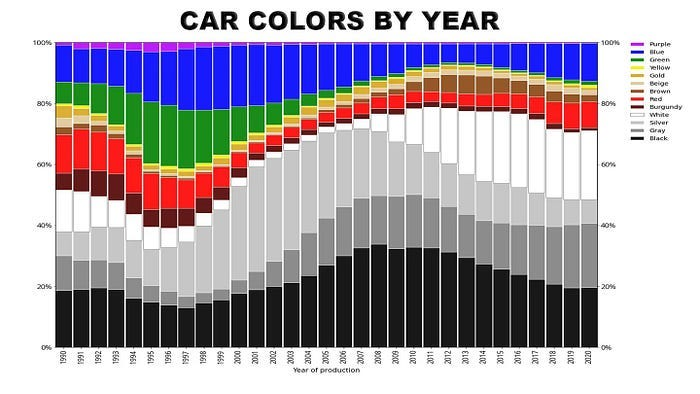
Huge opportunity to buck the trend then. And if you do have to stay monochrome, there’s still some fun to be had:
“differentiation may require going beyond color schemes and exploring innovation in shapes, materials, textures, patterns, or the ways users interact with a design.”
And finally…
Behold! List inception! Wikipedia’s list of lists of lists. And just like that, I ended up reading a list of Danish football transfers during summer 2017 🤷♀️
A comprehensive guide to yellow stripey things and the difference between the likes of bumblebees, honey bees and wasps.
Anne Quito on Milton Glaser’s invention of the I ❤️ NY logo. Turns out Glaser also designed the Brooklyn Brewery logo. Good fact, that.
Bon weekend,
Fran