Mind the moat
Jeff Green recently cited research by Michael Farmer, who analysed the world’s top 60 companies (by advertising spend) and their last 15 years of revenue growth. He found that 43 of them haven’t kept up with nominal GDP growth, including every CPG company on the list. Yikes.
There are lots of factors involved here, of course. But one stop on the blame train is that these companies aren’t building brands like they used to. Instead, they’re focussing on short term results, efficiency and performance marketing. And Will Poskett adds that even the biggest brands are losing their competitive moats:
“Scale, distribution, product innovation and operational excellence once made the giants almost untouchable. Today, those advantages are increasingly easy to replicate [...] Creativity and brand building are becoming the last great competitive moats. Because when everyone can make similar products, access the same technology and reach consumers through the same channels, the real advantage becomes making people care. Building something distinctive. Something meaningful. Something that earns a place in culture and memory. Because products can be copied overnight. What a brand means to people can't.”

24 strategists walk into a map
Iolanda Carvalho, Amy Daroukakis, Ci En Lee and Gonzalo Gregori have compiled more trend reports than you can shake a fibre-maxxed creatine cold foam at. Brace yourselves.
Meanwhile, Carissa Estreller asked 24 strategists for a signal they think will reshape how people live, consume, create or behave in 2027 and mapped the answers.
Before you place your bets
Before we all get tooooo stuck into the Times New Roman tea leaves and start acting on those trends and predictions, Michael Mullany’s 8 lessons from 20 years of hype cycles (h/t Neil Perkin) is a useful dash of history to stir in.
“In general, we're bad at making predictions. Out of the more than 200 unique technologies that have ever appeared on a Gartner Hype Cycle for Emerging Technology, just a handful of technologies - Cloud Computing, 3D Printing, Natural Language Search, Electronic Ink - have been identified early and traveled even somewhat predictably through a Hype Cycle from start to finish.”
“Is this what success looks like?”
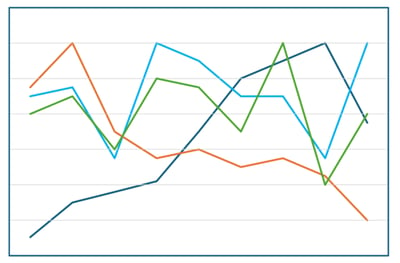
Phil Adams reckons his career peaked early. And late. And also possibly somewhere in the middle. He’s plotted his hours worked (orange), money earned (dark blue), fun had (green) and pride felt (light blue) to figure out what professional success looks like.
And finally…
Provided you’re not wedged between a stag do and an abandoned kebab on the 11.52pm out of London Waterloo on a Saturday night, rocking around on a locomotive is a lovely way to travel. Sami Smith has built a simulator that lets you stare out the window of trains around the world.
A lace handkerchief, a buttoned glove and assorted coins sound like the contents of my granny’s handbag. It’s just missing a few errant Rummikub tiles (anyone remember this smug little weasel?). But they are, in fact, the contents of an ostrich’s stomach (ca. 1930).
Jon Keegan has been analysing 50,000 boat names. Hats doffed to whoever came up with ‘Bilboat Baggins’, wherever you moor your skiff. Reminds me of the superb names given to Scottish road gritters. Gritney Spears does me in every time.
Bon weekend,
Fran